Application
Five causes of cracking in industrial floors — and which one is not a material problem
Plastic shrinkage, drying shrinkage, settlement, joint errors and overload. Most slab cracking is a process problem, not a material one — how to tell them apart.
The first reflex on seeing a crack is to question the material. Yet most of the cracking we meet in industrial floors comes from the process, not the material. Five main causes, and the signature of each:
1. Plastic shrinkage cracking
When: In the first hours after the pour, before the concrete sets. Appearance: Short, fine, randomly oriented surface cracks that are not parallel. Why: When the rate of evaporation from the surface exceeds the rate at which bleed water reaches it. Wind, low humidity and high temperature trigger it.
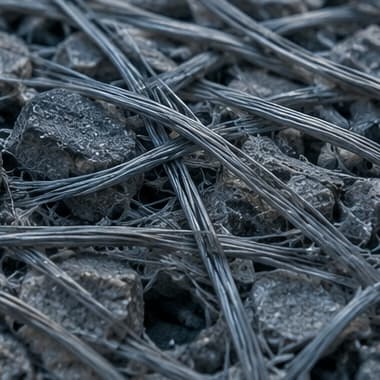
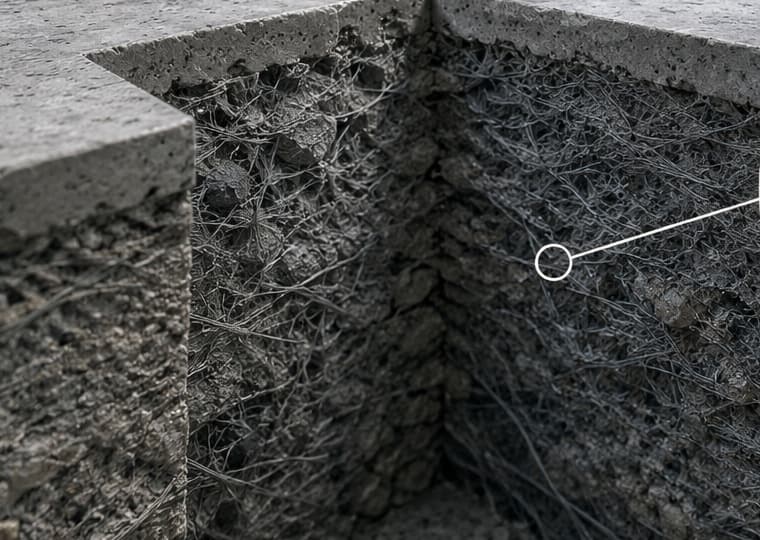
Micro fibre reinforcement is the specific answer for this window: it bridges the micro-cracks of the plastic phase before they grow.
2. Drying shrinkage cracking
When: Over a period spanning the first weeks into months. Appearance: Straight cracks running across the slab, independent of the joints. Why: When the concrete dries, shrinks, and that movement is restrained.
Two things work together here: macro fibre keeps crack width under control, and the joint layout collects shrinkage along planned lines. Neither is sufficient alone.
3. Settlement and sub-base cracking
Appearance: Cracks running along a line, usually through the full section. Why: Inadequately compacted fill, differential settlement, service trench crossings.
This is the one line no reinforcement can solve. On a pour started without a sub-base report, neither fibre nor mesh will save the result.
4. Joint-related cracking
Appearance: A crack continuing from the end of a cut joint, or running parallel between joints. Why: Joints cut too late, cut too shallow, or spaced too widely.
Joints should be cut one to three days after the pour, to a depth of at least a quarter of the slab thickness. With a joint profile, movement collects along the planned line and edge spalling is prevented too.
5. Overload and impact
Appearance: Star-shaped cracking around rack legs, spalling at edges and corners. Why: Design load exceeded, or point loads that were not in the calculation.
This is where macro fibre contributes most visibly: impact resistance and edge/corner crack control make a clear difference exactly where steel mesh is weakest.
In short
Reading the crack type correctly determines the remedy. If there is a problem in your slab, send us a photograph and the slab section — let us work out together which line it comes from.