
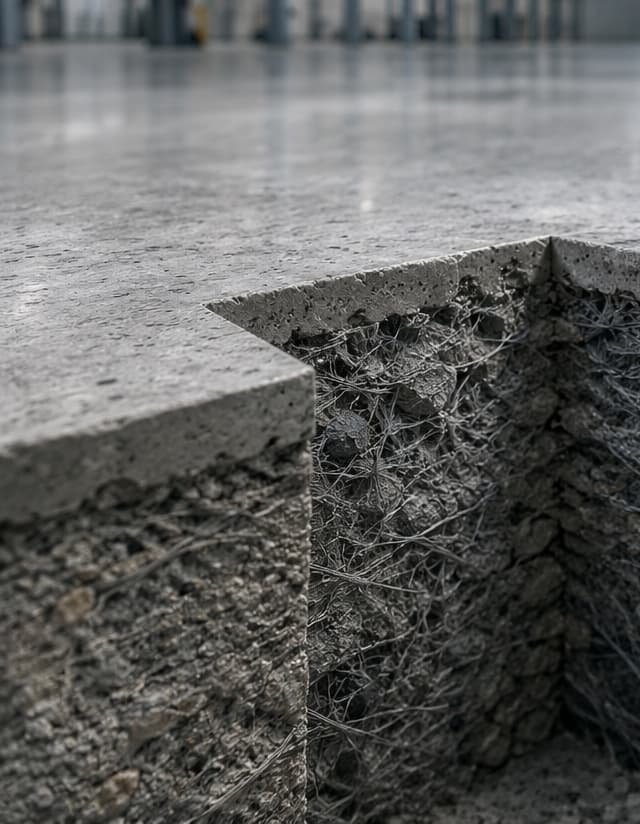
Three-dimensional reinforcement for concrete

MACRO FIBRE REINFORCEMENT

Its single-filament copolymer structure prevents crack formation and raises concrete performance. By controlling shrinkage and thermal cracking it improves fatigue strength, impact resistance and durability in acidic or saline environments.

Dosage

1–10 kg/m³ depending on the application. For sprayed concrete and ground slabs the common range is 2–4 kg/m³.

Macro Fibre Reinforcement

Standards

Technical specifications

Its single-filament copolymer structure prevents crack formation and raises concrete performance. By controlling shrinkage and thermal cracking it improves fatigue strength, impact resistance and durability in acidic or saline environments.

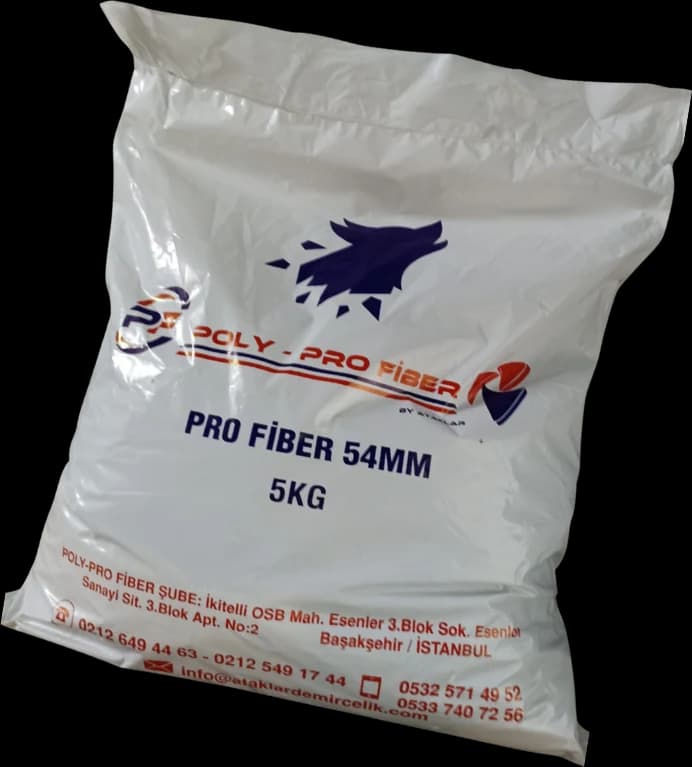
Macro Fibre Reinforcement product packaging
POLY-PRO FIBER 54 mm in 5 kg bags
PropertyValue
Raw material100% pure copolymer PP/PE
Length54 mm
Tensile strength550–750 MPa
Modulus of elasticity5.75 GPa
Fibre count220,000 per kg
Density0.91 g/cm³
Melting point162–168 °C
Water absorptionZero
StandardASTM C-1116 · EN 14889-2:2006 Type 2

Advantages

  • Crack prevention and crack-width control
  • Complete immunity to corrosion — polypropylene composition
  • Light and efficient application
  • High elasticity and strength
  • Reduced segregation
  • 50% reduction in application time
  • Increased impact resistance
  • High bond and elastoplasticity
  • Reduces surface wear
  • Prevents shrinkage cracking
  • Three-dimensional (3D) reinforcement
  • No steel mesh installation
  • No concrete cover required
  • Lower labour cost and slab thickness

Applications

  • Yard and ground slabs
  • Residential construction
  • Coastal structures
  • Water structures — hydro plants, treatment, irrigation, hydrology
  • Tunnels and mining
  • Precast elements
  • Industrial floor slabs
  • Car park decks
  • Concrete roads
  • Pool construction
  • Waste-water projects

Related certificates

Declaration of performanceEN 14889-2:2006

Declaration of Constancy of Performance

CE conformity certificate issued under the Construction Products Regulation (305/2011/EU) for Type 2 Poly Pro Fiber 54 mm polymer fibres. Factory production control verified under System 1.

Issued by
KGS — Türkiye Hazır Beton Birliği Kalite Güvence Sistemi
Document no
2055-CPR-306
Date
DOWNLOAD

Declaration of Constancy of Performance

KGS — Türkiye Hazır Beton Birliği Kalite Güvence Sistemi · 2055-CPR-306

Declaration of Constancy of Performance — Page 1
Quality managementTS EN ISO 9001:2015

TS EN ISO 9001:2015 Quality Management System

Quality management system certificate covering the manufacture of concrete fibre reinforcement products and construction chemicals, industrial flooring applications and road logistics services.

Issued by
UKS Uluslararası Kalite Sistemleri ve Belgelendirme
Document no
K-6174
Date
DOWNLOAD

TS EN ISO 9001:2015 Quality Management System

UKS Uluslararası Kalite Sistemleri ve Belgelendirme · K-6174

TS EN ISO 9001:2015 Quality Management System — Page 1
Test reportEN 14651

İTÜ Technical Report — 2.0 kg/m³

EN 14651 flexural test results on C30 concrete prisms containing POLY-PRO 54 M macro synthetic fibre at a dosage of 2.0 kg/m³.

Issued by
İTÜ Deprem Mühendisliği ve Afet Yönetim Enstitüsü
Document no
2023-DE293A
Date
Test dosage
2 kg/m³
DOWNLOAD

İTÜ Technical Report — 2.0 kg/m³

İTÜ Deprem Mühendisliği ve Afet Yönetim Enstitüsü · 2023-DE293A

İTÜ Technical Report — 2.0 kg/m³ — Page 1
1 of 3
Test reportEN 14651

İTÜ Technical Report — 3.0 kg/m³

EN 14651 flexural test results on C30 concrete prisms containing POLY-PRO 54 M macro synthetic fibre at a dosage of 3.0 kg/m³.

Issued by
İTÜ Deprem Mühendisliği ve Afet Yönetim Enstitüsü
Document no
2023-DE293B
Date
Test dosage
3 kg/m³
DOWNLOAD

İTÜ Technical Report — 3.0 kg/m³

İTÜ Deprem Mühendisliği ve Afet Yönetim Enstitüsü · 2023-DE293B

İTÜ Technical Report — 3.0 kg/m³ — Page 1
1 of 3
Certificates

FAQ

Questions about this product

ANSWERS BEFORE YOU POUR
Can macro fibre fully replace steel mesh?

For ground slabs, industrial floors and car parks, yes. Its three-dimensional distribution behaves more homogeneously than the two-dimensional reinforcement a mesh provides, and it controls edge and corner cracking too. For structural elements needing a static calculation, your project engineer’s approval remains essential.

How much fibre goes into a cubic metre?

Between 1 and 10 kg/m³ depending on the application. For ground slabs and sprayed concrete the common range is 2–4 kg/m³. We calculate the exact figure from your loads, slab thickness and exposure class, and state it in writing.

Does the fibre corrode over time?

No. The 100% polypropylene copolymer structure gives complete immunity to corrosion and water absorption is zero — which is why it outperforms steel mesh in coastal structures, water projects and waste-water applications.

Does application need special equipment or skilled labour?

No. The fibre is added to the concrete in the truck mixer and mixed until dispersion is homogeneous. The ironworking, concrete cover and installation time a steel mesh requires disappear entirely.

Does it affect the workability of the concrete?

At the correct dosage it reduces segregation and improves surface quality. At high dosages consistency can drop; a plasticiser then restores the balance. That adjustment is part of the dosage recommendation we give you.

Which standards does the material comply with?

Macro fibre complies with ASTM C-1116 and the steel wire reinforcement with TS 10513. Quality management is certified to UKS ISO 9001, and performance consistency certificates are supplied with each batch.

LET'S START WITH YOUR SLAB

Tell us the area, the load class and the pour date. An engineer will come back to you within one working day with a dosage recommendation.